


In the landscape of American finance, the journey to security and wealth often follows two distinct paths. These paths are not just defined by income, but by fundamentally different tools, strategies, and mindsets. By examining the typical profiles of "Middle America" and "Wealthy America," a clear picture emerges of how financial trajectories are shaped.
Family A: Middle America (The 95%) represents the overwhelming majority, with a household income at or below $100,000. Their financial life is built on a foundation of employment, making their paycheck a lifeline and leaving them vulnerable to economic disruption. In contrast, Family B: Wealthy America (The Top 5%) earns $250,000 or more and typically operates from a position of control, often as business owners or high-level professionals, which allows them to dictate their income flow rather than depend on an employer.
Regarding savings and income, Family A tends to keep money in standard bank accounts, a safe move that yields minimal returns, often failing to outpace inflation. Family B, conversely, puts capital to work across a diversified portfolio of assets like real estate, businesses, and securities, focusing on growth rather than preservation alone.
When it comes to assets and debt, Family A is more likely to rent, missing the opportunity to build equity, while often carrying high-interest consumer debt that erodes their income. Family B typically owns their home, builds equity, and uses debt strategically—if at all—such as taking low-interest loans to fund investments that yield higher returns.
In the realm of insurance and retirement, Family A often relies on term life insurance or has none, and their retirement hinges on employer-sponsored plans like 401(k)s, exposing them to market risk and future taxes. Family B utilizes permanent life insurance policies, which provide a death benefit while building cash value with tax advantages, and supplements retirement with other advanced, tax-efficient vehicles.
A crucial difference lies in planning and advice. Most of Family A navigates complex finances alone, without a long-term plan or a financial advisor, often reacting to life events. Family B almost universally works with financial professionals to design and maintain a comprehensive, strategic plan for the long term.
Finally, their tax strategies diverge significantly. Family A’s financial structure affords minimal tax advantages; they pay taxes as they earn and potentially again when withdrawing retirement funds. For Family B, their entire financial ecosystem is designed for maximized tax efficiency, strategically managing income and gains to legally minimize their lifetime tax burden.
Overall, for Family A, financial life is a precarious monthly balancing act where security feels just out of reach. For Family B, finance functions as a coordinated engine designed for sustained growth, asset protection, and legacy building.
The Big Picture: Strategy, Not Just Salary
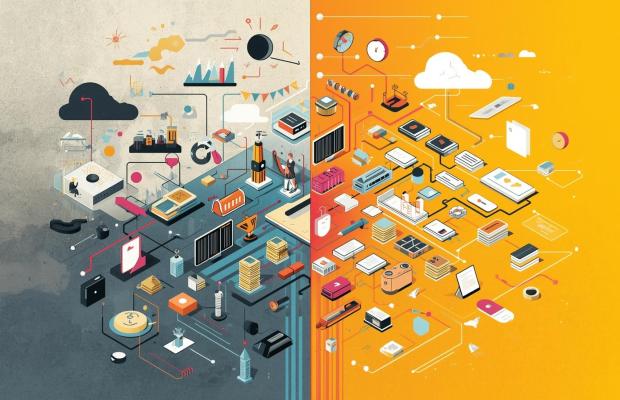
When placed side-by-side, the contrast reveals a powerful truth: the wealth gap is as much a strategy gap as an income gap.
Family A’s approach is largely linear: work, save in bank, invest in a taxed retirement account, hope it’s enough. Their tools, while sound, are basic and come with inherent risks and limitations.
Family B’s approach is multidimensional: controlling income, investing in assets, utilizing tax-advantaged growth vehicles, and leveraging expert guidance. Their tools are chosen not just for returns, but for efficiency and control.
The goal here is not to judge but to illuminate. Understanding these differences highlights that financial progress isn't solely about earning more money, it's about mindset, planning, and access to the right financial strategies. For those in "Middle America," the path forward begins with education, seeking professional advice, and understanding that the financial tools used by the wealthy are often available to anyone who learns to navigate the system. The first step toward changing a financial trajectory is recognizing that a different path exists.